
Introduction and Overview
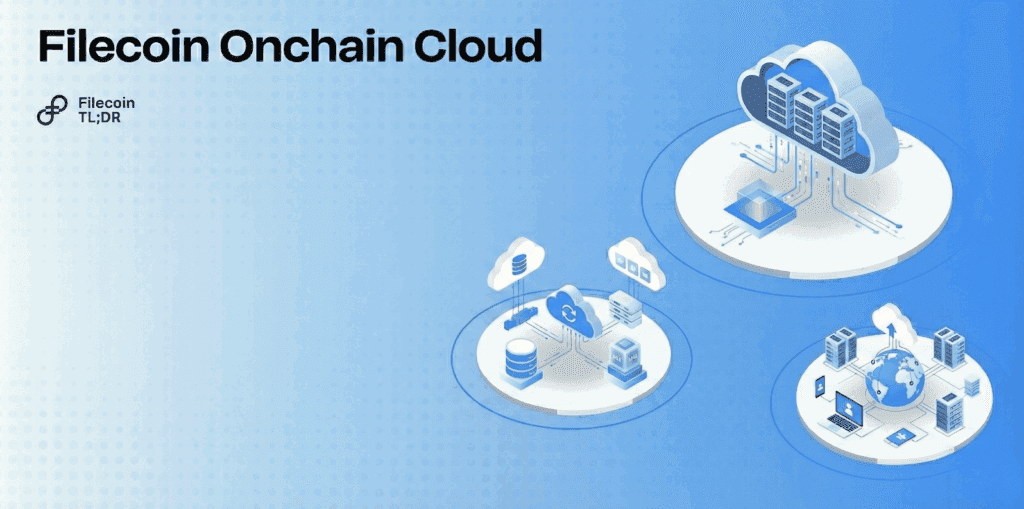
In this post, we explore what the Filecoin Onchain Cloud (FOC) is, why it matters, and how it turns the Filecoin network into a trustless, programmable cloud layer for the open data economy:
- What FOC Is and Why It’s Needed
We start by explaining what Filecoin Onchain Cloud is, why it was developed, and what it enables. This section highlights the core components, architecture, and foundational services that make programmable, verifiable, and trustless cloud workloads possible and how these capabilities strengthen the Filecoin ecosystem. - Use-Case Verticals and Real-World Builders
We then outline the key use-case verticals enabled by FOC For each vertical, we highlight both potential opportunities and the early integrations. - Developer Resources & Ways to Get Involved
Finally, we share tools, resources, and actionable next steps for developers, storage providers, and ecosystem participants looking to build on FOC.
1. What is Filecoin Onchain Cloud and What It Unlocks
The Filecoin Onchain Cloud (FOC) marks a major milestone in Filecoin’s evolution, transforming the network from a storage provisioning protocol into a programmable, verifiable, and composable onchain cloud platform.
First introduced at Filecoin Dev Summit 5 (FDS-5), FOC builds on the foundations of Filecoin Web Services and formalizes it as a core part of the Filecoin roadmap. It was born out of a recurring question within the community: “What is Filecoin, and how can anyone easily use it to power everyday application storage needs?”
After five years of growth, the network had expanded significantly, but builders still sought easier ways to leverage Filecoin for everyday application storage needs. FOC was developed to make Filecoin more usable, flexible, and aligned with the demands of modern Web3 developers and applications. Filecoin Onchain Cloud officially launched on November 18th, marking the beginning of this new chapter for the Filecoin network.
Why It’s Needed and What It Unlocks
At its core, Filecoin Onchain Cloud (FOC) turns Filecoin from a decentralized storage network into a fully programmable onchain cloud. It is the next step in the network’s evolution, made possible by prior upgrades: the Filecoin Virtual Machine (FVM), Proof of Data Possession (PDP) and F3 retrieval guarantees. These upgrades unlocked the ability to bring together Filecoin’s three core markets – storage, retrieval, and compute into a single layer.
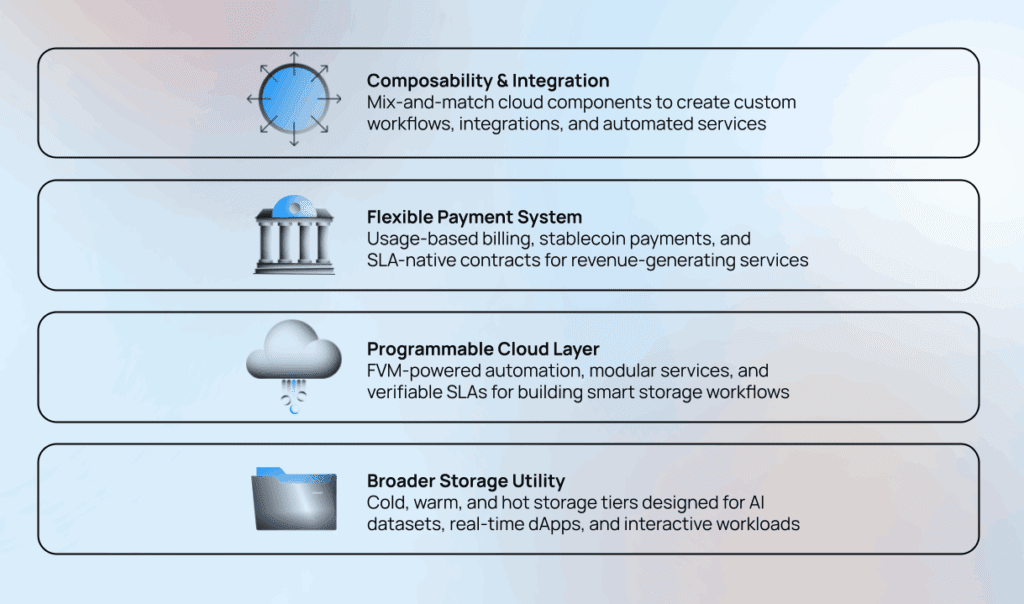
On top of this foundation, FOC provides developers, storage providers, and users with a set of capabilities that address modern application needs and enable new types of services, which are outlined below:
- Composability and Integration: FOC supports modular and composable cloud components, allowing builders to combine, and remix services. (For example: combining Filecoin Warm Storage Services + Filecoin Beam + Filecoin Pay allows a developer to create a verifiable, usage-based backup service with automated scheduling and billing)
- Flexible Payment System: Tools like Filecoin Pay and SLA-native payment contracts let service creators run revenue-generating offerings with recurring and stablecoin-based payments (e.g., USDFC). This helps power a robust, programmable onchain economy.
- Programmable Cloud Layer: Existing decentralized storage infrastructure often lack programmability and automation, making it difficult to run complex workflows or enforce service-level guarantees. Filecoin Onchain Cloud (FOC) solves this by turning Filecoin into a fully programmable onchain cloud via the Filecoin Virtual Machine (FVM). Developers can deploy modular, verifiable services with onchain guarantees, enabling automated storage workflows, Service Level Agreements (SLA) – based agreements, and composable infrastructure for diverse applications.
- Broader Storage Utility: Filecoin began as a cold storage network for archival data, but modern Web3 applications – like AI datasets, real-time dApps, and interactive platforms – demand fast, warm, and cold storage tiers. FOC meets this need, enabling dynamic access to data while maintaining verifiability.
By enabling new services and economic activity, FOC solidifies Filecoin as a foundational programmable cloud for Web3.
How It Works: Architecture and Core Components
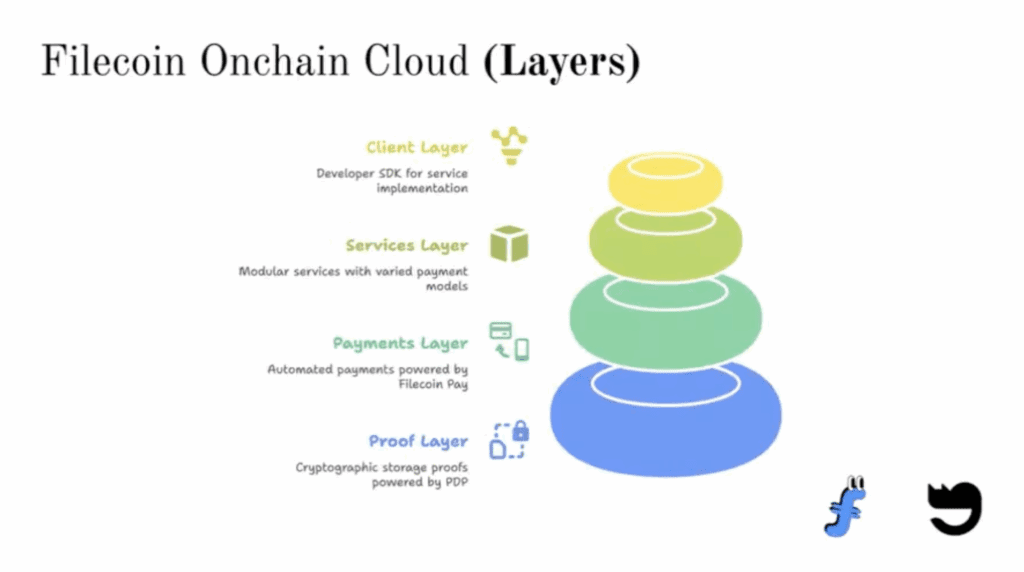
Filecoin Onchain Cloud is structured into four key layers that abstract complexity for developers:
- Proof Layer
- Handles cryptographic guarantees for data storage.
- Uses Proof of Data Possession (PDP) to verify that files are securely stored.
- Combined with the payment layer, it enables verifiable warm storage services.
- Payment Layer
- Managed by a central smart contract called Filecoin Pay.
- Supports one-off and recurring payments using stablecoins like USDFC, as well as other ERC20 tokens.
- Payments are conditional on storage proofs, ensuring services are delivered as promised.
- Services Layer
- Hosts core FOC functionality and modular services for builders.
- Allows the creation of new applications and services leveraging proof and payment guarantees.
- Client Layer
- Provides developer-friendly interfaces (SDKs, CLIs) for interacting with FOC services.
- Example: Synapse SDK, which simplifies integration and workflow automation.
Core Services: Building Blocks of the Onchain Cloud
The core of Filecoin Onchain Cloud starts with five open source, verifiable, and composable building blocks:
- Filecoin Warm Storage Service – Ensures your data is securely stored and available using Proof of Data Possession (PDP).
- Filecoin Pay – Enables onchain payments that are tied to verifiable service performance, supporting both one-off and recurring transactions.
- Filecoin Pin – Brings IPFS and Filecoin closer than ever for fast, decentralized, and persistent data storage.
- Filecoin Beam – Bridges verifiable data movement across onchain and offchain systems.
- Synapse SDK – Provides developers with simple APIs and interfaces to connect and interact with FOC services.
These building blocks form the foundation for a programmable, composable, and verifiable onchain cloud, allowing developers to create reliable applications with automated guarantees and measurable service performance.
2. Exploring Use Cases with Filecoin Onchain Cloud
Filecoin Onchain Cloud enables a wide range of applications, spanning AI, autonomous agents, web3 dApps, archival storage, and more. Here’s a breakdown by vertical:
AI and Autonomous Agents
Filecoin Onchain Cloud allows AI and autonomous agents to store models, execute tasks, and automate payments with onchain proofs. This enables trustless, usage-based workflows that traditional cloud systems cannot provide.
Current Integrations and Builders:
- Monad: EVM-based L1 providing low-latency compute paired with Filecoin Onchain Cloud’s verifiable storage for AI model training and deployment.
- ERC-8004: Open-source SDK enabling onchain AI agent creation and verifiable storage of agent metadata.
- Cairn: Rewards reproducible AI research using verifiable storage and Filecoin Pay.
- Groundline: Decentralized knowledge-graph database for AI and research teams.
Web3 dApps and Frontends
Filecoin Onchain Cloud provides Web3 applications with a verifiable foundation where storage and updates can be audited on-chain. Frontends can be deployed without centralized servers, using smart contracts and onchain coordination to control how content is stored, retrieved, and updated.
Current Integrations and Builders:
- Ethereum Name Service (ENS) and SAFE: Combines ENS onchain naming, Filecoin verifiable storage, and Safe multisig governance for resilient, user-controlled web experiences.
- Filosign: Onchain DocuSign alternative with cryptographic e-signatures.
- Cha-Ching: Rewards developers and AI agents for verified GitHub contributions.
- Eastore: Decentralized drive offering private, encrypted storage.
- Geo Podcasts: A Web3 podcast discovery app storing data and knowledge-graph records on Filecoin Onchain Cloud for verifiable, auditable content.
Archival, Web Preservation, and Storage Services
Filecoin Onchain Cloud offers verifiable storage for archival, web preservation, and data-heavy workloads such as AI and ML. Builders can create modular storage services with programmable payments and storage proofs. FOC supports both cold and warm storage, fast retrieval through Filecoin Beam, and IPFS integration, enabling higher-throughput applications with verifiable data.
Current Integrations and Builders:
- KYVE: Resiliently stores chain data from Celestia and Story Protocol across Filecoin providers.
- Storacha Forge: Verifiable warm storage for enterprise AI training data and DePIN telemetry.
- Akave Cloud: Decentralized backup and archiving tier with S3 compatibility and verifiable proofs.
DePIN Networks and Verifiable Infrastructure
Filecoin Ochain Cloud lets developers deploy DePIN applications – sensors, bandwidth, mapping services – directly on-chain with verifiable storage, retrieval, and payment workflows. It also supports local or sovereign cloud infrastructure for enterprises and regional providers.
Current Integrations and Builders
- dCipher: Enables fast, secure cross-chain settlement for assets and applications on Filecoin.
Expanding Potential Use Cases
While early builders are focusing on AI, Web3 dApps, archival storage, and DePIN networks, we’re particularly bullish on these areas because they demonstrate FOC’s capabilities. The examples below show where FOC can add value, though its potential goes beyond these verticals:
- Enterprise SaaS & Compliance Platforms: Automate SLAs, verifiable storage of client data, and recurring payments with stablecoins.
- Media & Content Platforms: Deliver content with verifiable access, usage-based payments, and faster retrieval.
- Financial Services & Document Workflows: Securely store records, link workflows to verifiable events, and automate payments.
- Data Marketplaces & Analytics Platforms: Sell datasets or APIs with verifiable delivery and automated payments.
- Hybrid Web 2.5 Applications: Integrate verifiable storage and programmable payments into existing applications.
3. Getting Started with Filecoin Onchain Cloud
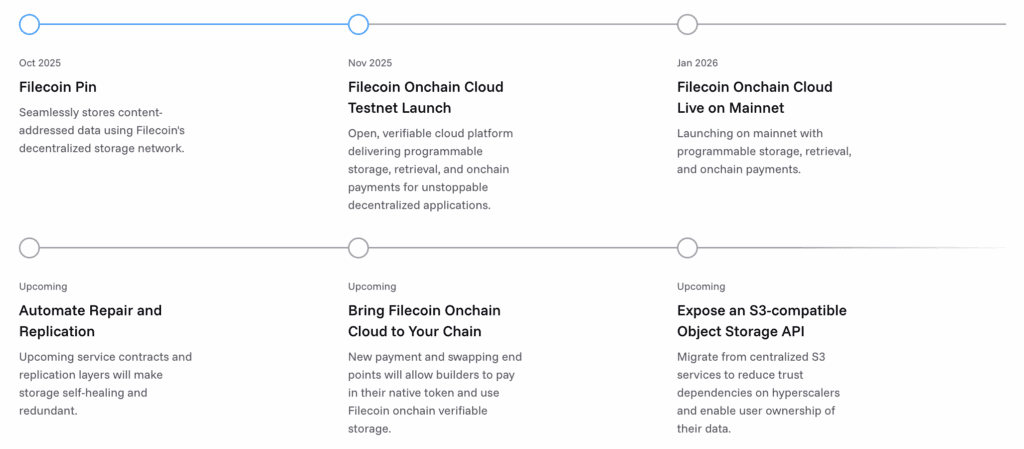
Filecoin Onchain Cloud is live on testnet and preparing for mainnet launch in January 2026.
Here are some resources to learn more about Filecoin Onchain Cloud:
- Watch the replay of the CoinDesk livestream unveiling Filecoin Onchain Cloud
- Watch the ‘Introduction to Filecoin Onchain Cloud’ primer covered on FDS-7
- Access the Official Filecoin Onchain Cloud documentation:
Explore all core services, developer tools, SDKs, and guides. This is your central hub for learning how to build, integrate, and deploy on FOC. - Dive into the FOC Stack with the Cheat Sheet by FIL Builders:
Get a detailed breakdown of the underlying infrastructure – from cryptographic storage and economic layers to full service implementation with the developer SDK. The cheat sheet helps builders understand how the components connect and how to leverage them effectively.
In Conclusion: Building the Cloud Layer of the Open Data Economy
The Filecoin Onchain Cloud extends Filecoin’s mission – transforming the world’s largest decentralized storage network into a programmable, verifiable, and composable cloud platform.
Where the FVM enabled base-layer programmability, the Filecoin Onchain Cloud adds a service layer that allows developers to create dynamic onchain applications capable of supporting modern workloads and competing with traditional cloud infrastructure.
If Filecoin’s first era created a decentralized data vault, the Filecoin Onchain Cloud adds the tools and infrastructure needed for developers to build reliable, accountable, and verifiable services on top of it.
Disclaimer: This information is for informational purposes only and is not intended to constitute investment, financial, legal, or other advice. This information is not an endorsement, offer, or recommendation to use any particular service, product, or application.