

Introduction
Filecoin has moved through three phases since mainnet launch: building storage capacity (2020–2022), improving usability (2022–2024), and, since 2025, generating paid demand – a shift formalized in the 2026 Filecoin Network Strategy. The strategy set out three priorities: increase paid, onchain deals; strengthen network profitability and cryptoeconomics; and scale adoption among paid, onchain flagship clients.
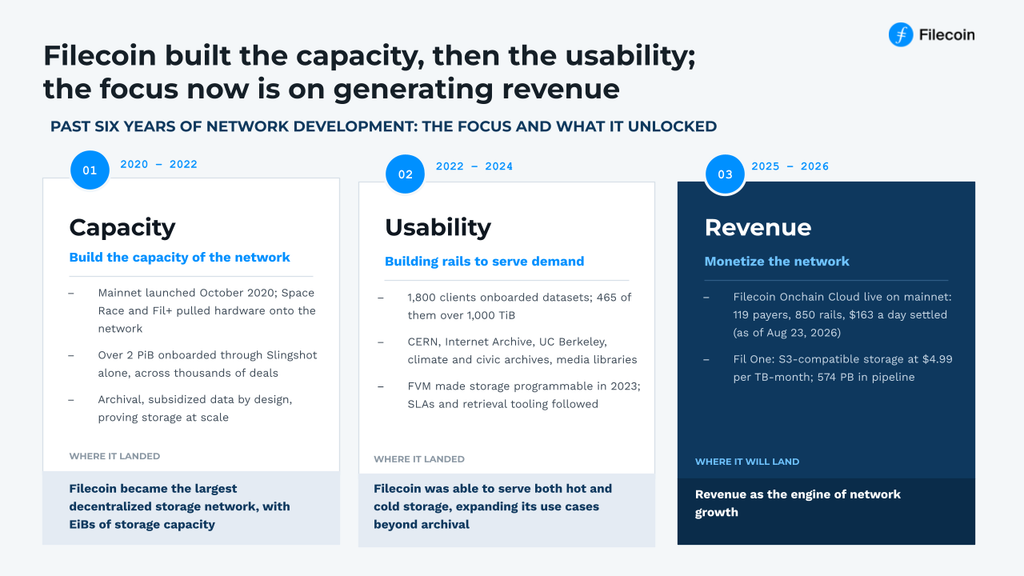
The year’s building blocks are Filecoin Onchain Cloud (FOC), which introduced onchain payments and programmable storage alongside the Synapse SDK, and Fil One, a path onto Filecoin for S3 workloads. Heading into Q4’26 and 2027, two sides of the picture are converging: demand is becoming measurable and growing, while FIL’s supply approaches its largest scheduled change since launch.
In this update, we will dive into three parts:
- Supply: two changes that tighten FIL’s cryptoeconomics in Q4’26
- Demand: the products are in market, and paid usage is growing
- What this convergence could mean for token holders and how to participate.
1. Supply: two changes that tighten FIL’s cryptoeconomics in Q4’26
FIL circulating supply is shaped by several moving parts: new FIL enters through block rewards and vesting, while collateral locking and token burns remove FIL from liquid circulation.
Q4’26 is notable because two important parts of that equation are changing: PL & FF vesting completion in Oct’26 and Solstice (FIP-0118) projected for nv29.
PL & FF vesting completes in October ’26
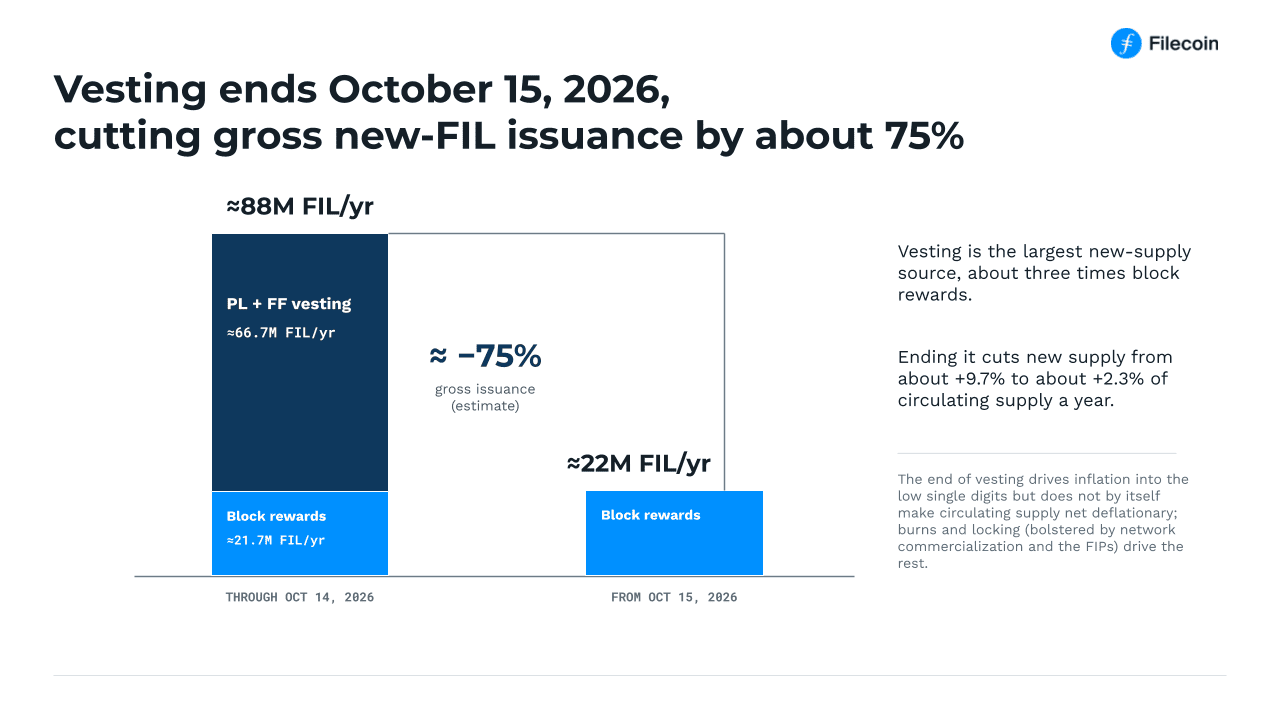
Vesting has been a predictable source of new FIL since network launch, and the largest one. New FIL currently enters circulation at close to 10% of supply a year, of which PL and FF vesting adds about 66.7M FIL annually against roughly 21.7M from block rewards. On October 15 that source stops, cutting gross issuance by roughly 75%. What’s left is block rewards alone, about 22M FIL a year, or a little over 2% of circulating supply.
Vesting ending changes what enters circulation, not what circulating supply does next; burns and collateral locking decide the rest. Simulations using the FIL Tokenomics Simulator suggest that, depending on network conditions, daily net supply growth could fall by roughly 86% to 119% from August 2026 levels by end 2027. At the upper end of that range the daily supply delta turns negative, meaning FIL becomes net deflationary, with more FIL leaving circulating supply than entering it.
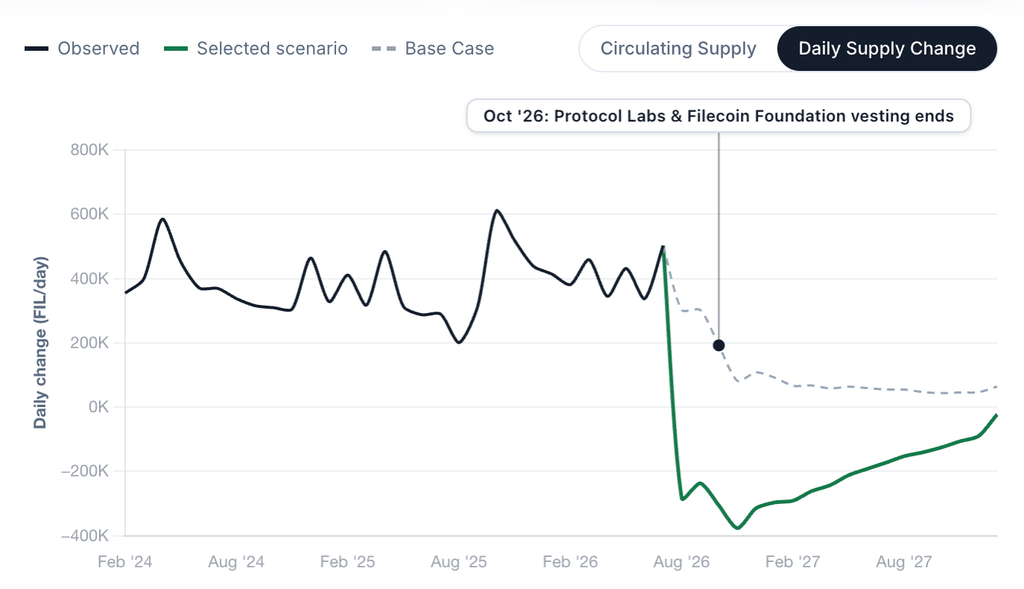
These are modeled scenarios rather than forecasts, and outcomes depend on factors including network demand, block rewards, collateral and burns.
Solstice (FIP-0118) moves Filecoin toward more demand-aligned cryptoeconomics
FIP-0118 proposes a significant redesign of Filecoin’s reward system. Its aim is to move beyond the existing Fil+ model and create a protocol-level mechanism that funds the services responsible for bringing paying customers and workloads to Filecoin.
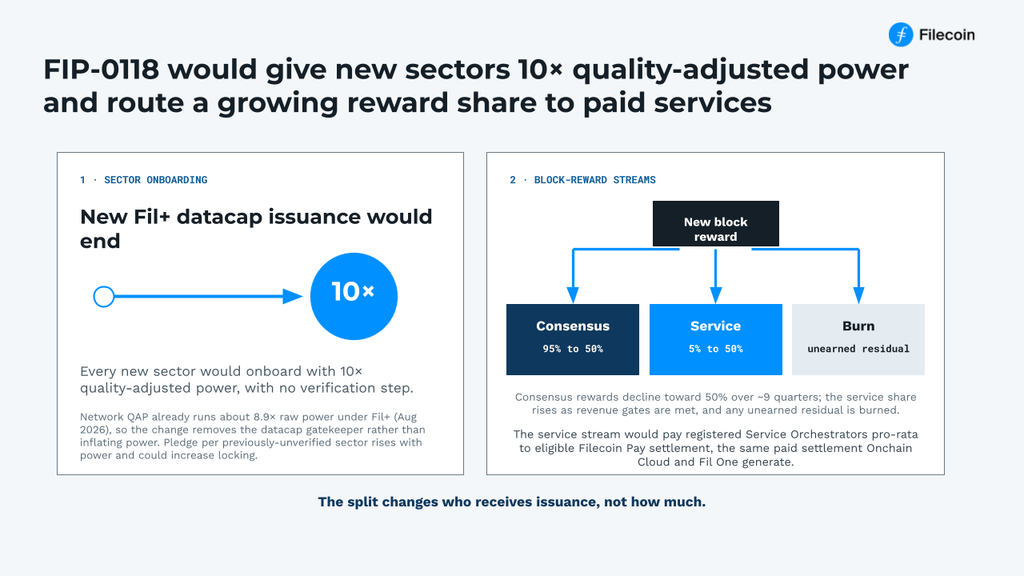
Today, Fil+ uses DataCap to give verified deals additional quality-adjusted power. Under Solstice, that verification layer would be removed: every new sector would onboard at 10x quality-adjusted power with no verification step, while a separate portion of block rewards would fund services focused on generating paid network usage. This broadly matches the official Solstice framing of replacing human verification with a more direct signal of customer activity.
For the FIL economic loop, the important change is that this service funding would become tied to measurable demand:
- A portion of Filecoin block rewards would fund services that drive paid network usage.
- That portion could grow only as onchain Filecoin Pay volume meets predefined targets.
- If those targets are not met, the corresponding rewards would be burned rather than distributed.
The result is a more demand-responsive reward system: stronger paid usage supports more service funding, while weaker usage means less FIL is distributed.
| Today | Under FIP-0118 (proposed) | |
| The 10x reward multiplier (QAP) | Requires FIL+ datacap – human-reviewed allocation | Automatic for every new sector |
| Block rewards go to | Miners, based on storage power | Split: miners (declining share) + service operators (growing share, if revenue targets are met) |
| Is issuance tied to usage? | No – block rewards are distributed the same regardless of paid usage | Distribution is: the service share is released as paid settlement clears quarterly gates |
| If settlement falls short | Nothing changes | The unearned share is burned – net new supply falls |
For tokenholders, that creates a tighter feedback loop between network activity and FIL’s cryptoeconomics. Rather than service incentives expanding independently of demand, the system would increasingly require paid usage to justify that distribution – otherwise the unearned allocation is removed from supply.
FIP-0118 was accepted in September and awaits scheduling into a network upgrade; implementation details can still be refined until it ships, and the table reflects the spec as of September 1, 2026.
2. Demand: the products are in market, and paid usage is growing
A key objective set out in the 2026 network strategy is paid demand: storage that someone outside the ecosystem pays for, settled onchain.
In April we identified three trends moving in Filecoin’s favor: data growing faster than centralized storage can absorb, AI pushing value and trust requirements down into the data layer, and lock-in costs becoming harder to ignore. Six months on, those trends have held. Neoclouds such as CoreWeave and Nebius showed that buyers will go outside the hyperscalers when a workload calls for it, and that specialized compute needs a storage layer that can prove what it holds, not just hold it. And while the EU Data Act bans cloud switching charges from January 2027, the rules stop short of egress: leaving got cheaper, but every byte you pull out still bills.
Here’s where the products stand:
Filecoin Onchain Cloud: paid usage, measurable and growing
FOC launched mainnet in Q1’26, building on the multi-year vision of a composable marketplace with storage and onchain payment rails, connecting applications to storage, proof, retrieval, and payment.
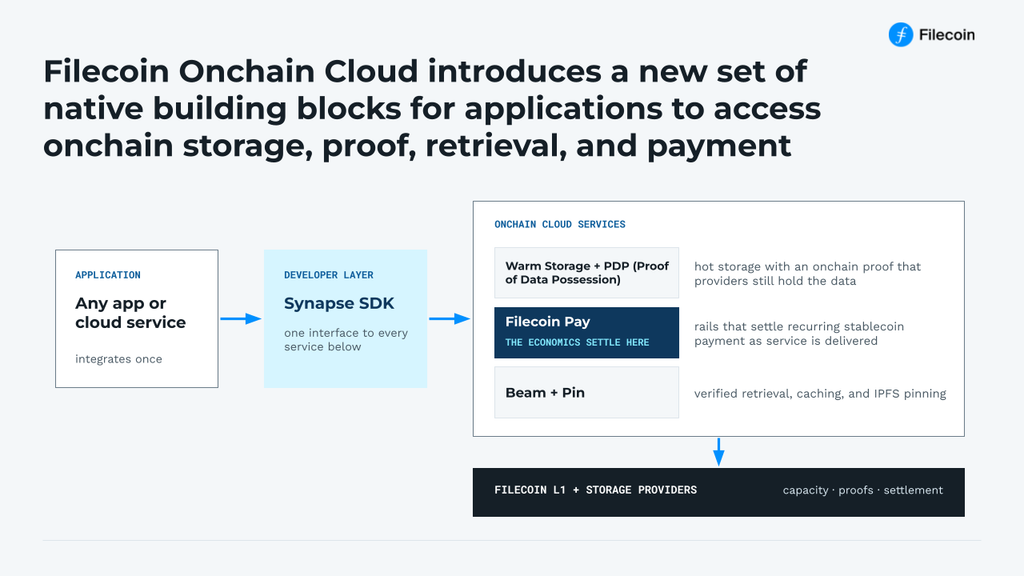
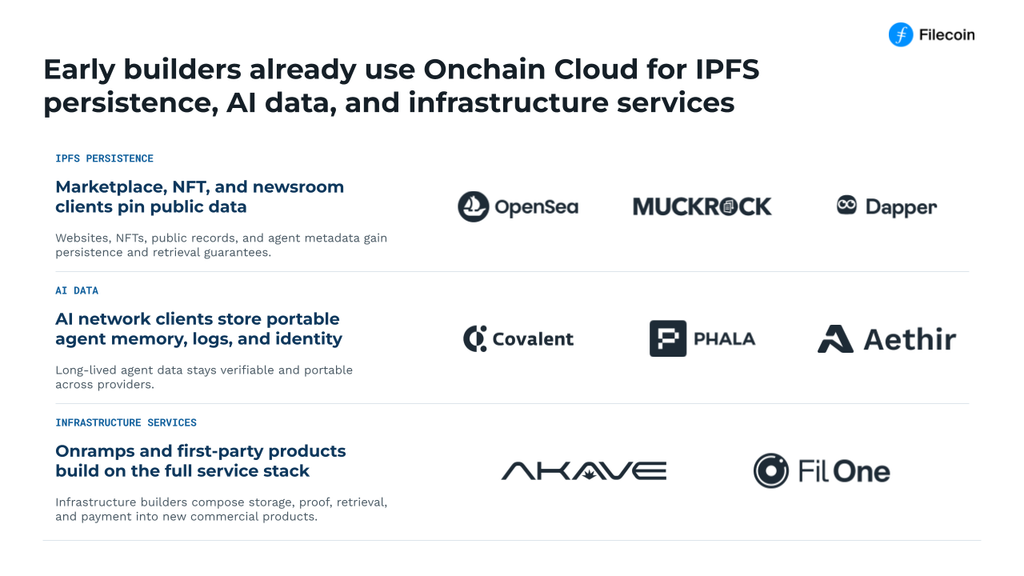
Early adoption falls into three groups
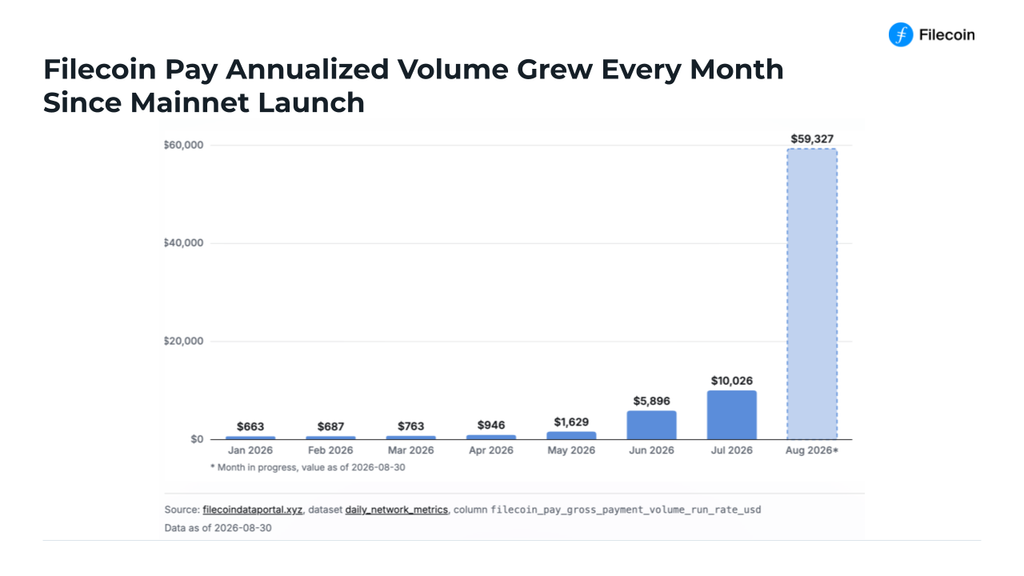
Filecoin Onchain Cloud usage is measurable on mainnet, and accelerating
As payment on FOC settles onchain through Filecoin Pay, usage can be measured directly rather than reported. Filecoin Pay’s annualized run-rate grew from $663 in January to $59,327 at the end of August. Active Payers rose from 73 to 119 over the same period, and Active Rails stood at 865 as of August.
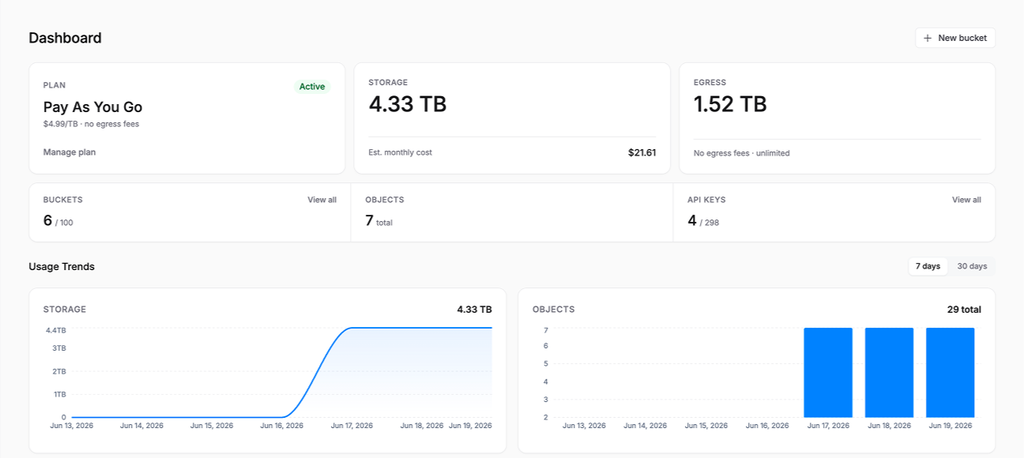
Fil One: S3 storage at $4.99 per TB, no egress
Fil One, launched in June, is S3-compatible object storage backed by Filecoin, priced at $4.99 per TB-month with no egress fees. An application, backup tool, or pipeline that already talks to S3 can talk to Fil One by changing an endpoint and a set of credentials, and every object is re-verified on the network roughly every 24 hours.
| Price | $4.99 per TB-month; no egress or API request charges; $4.99 monthly minimum |
| Integrity | Content identifier assigned at upload, re-checked about every 24 hours |
| Durability | 11 nines |
| Compatibility | Existing S3 SDKs and CLIs connect by changing the endpoint; managed migration available |
| Regions | US and EU; more forthcoming |
| Terms | Pay as you go, or 1-, 3-, and 5-year reserved capacity |
| Trial | 1 TB free for 30 days, no card required |
| Roadmap | Bucket Intelligence and AI Agent Toolkit, both in early access |
Why it matters is scale. Enterprise object storage is measured in exabytes and millions of dollars, and Fil One is aimed squarely at it. Every enterprise account it wins becomes paid, onchain storage that the Filecoin network can measure.
Filecoin Onramp Update
Onramps are where enterprise demand shows up first. They sell managed storage to large clients, handle the contracts and compliance, and use Filecoin as the layer underneath, so their funding rounds, product releases, and customer wins are the most direct read on whether the network is being bought for real workloads.
Akave
Akave Cloud is an S3-compatible, compute-agnostic storage platform for enterprise and AI data, using Filecoin as its storage layer and settling on its own Avalanche-based chain.
- Fundraising: Akave raised $6.65M in March and formally entered the storage market with Akave Cloud
- Product: O3 went from PDP integration and a trustless GUI at v1.2 to multipart uploads, IAM, and Object Lock by v1.7; the protocol layer added per-file encryption keys and faster erasure reconstruction.
- Clients and integrations: Intuizi reports more than 50% lower storage costs and 60% faster analytics after moving to Akave, and The Defiant is among the enterprise clients. Integrations with Snowflake, Akash, and Hugging Face put Akave-stored data in reach of GPU compute and mainstream AI tooling.
3. The convergence, and how to follow it
Putting the two halves together: the demand side now has two things working for it. Paid usage that is demonstrated onchain and accelerating month over month, and Fil One, a first-party product aimed at the S3 and enterprise object storage markets, which are measured in exabytes.
The supply side changes in October, when vesting ends and block rewards become the only source of new FIL. From there, whether circulating supply grows or shrinks comes down to burns and collateral locking, and both of those move with usage. FIP-0118 would tighten that further, releasing part of the block reward only when onchain payment volume hits its targets and burning it otherwise.
Convergence can meaningfully happen once the tightening supply coincides with accelerating demand. to track this in primary sources:
| What to explore | Where |
|---|---|
| Demand | Revenue Growth (Quantitative) | Onchain ARRFilecoin Pay Active PayersPaid deals on Filecoin (self-declared by onramps) |
| CryptoEcon | FIL Tokenomics Simulator | FIL Tokenomics Simulator |
| Governance | Solstice (FIP-0118) | FIPs discussion #1249 |
| Macro Themes | Use cases for Filecoin | FilecoinTLDR Blog |
And for those who want to participate FIP and pre-FIP discussions are open to all token holders, staking options are covered in our guide to staking FIL, and our seasonal FilecoinTLDR Builder Challenges offer a hands-on way into the ecosystem.
Keep exploring Filecoin
- Follow Filecoin and FilecoinTLDR for ecosystem explainers and updates
- Join the Filecoin Discord to connect with the community.
- Subscribe to the newsletter for future posts and insights.
Disclaimer: This information is for informational purposes only and is not intended to constitute investment, financial, legal, or other advice. This information is not an endorsement, offer, or recommendation to use any particular service, product, or application.