

Solstice (FIP-0118), is a major redesign of Filecoin’s reward system.
For most of Filecoin’s history, block rewards have primarily been tied to supplying and securing storage. Solstice changes that by making part of the reward system more responsive to actual demand on the network.
It also retires Filecoin Plus, marking a broader shift in Filecoin’s cryptoeconomics: issuance shaped not only by how much storage the network supplies, but increasingly by whether that supply translates into paid usage.
In this post, we cover three things:
- What Solstice changes – the before and after
- How Solstice works – the reward streams, demand gate, and burn
- What the split looks like under different demand paths – using our interactive simulator
1. What Solstice changes
Solstice was accepted in early September 2026 and will take effect with the upcoming nv29 network upgrade. To understand what changes, it helps to start with how Filecoin rewards work today.
How rewards work now
The Filecoin network pays storage providers newly minted FIL, or block rewards, for winning blocks. A provider’s chance of winning is proportional to its quality-adjusted power (QAP): the more QAP it has relative to the network, the larger its expected share of rewards.
The “quality” part is where Filecoin Plus comes in. Fil+ was designed to steer more rewards toward storage tied to real client use cases. Clients apply for datacap, and sectors storing datacap-backed data receive 10× the power of unverified sectors.
In that sense, Fil+ has served as a proxy for demand. But it relies on human review, and approval tells the protocol that data has been accepted as useful, not whether a customer actually paid for the service.
There is also no protocol-level mechanism today for directing part of block rewards toward the work of bringing paying customers to Filecoin, such as sales, integrations and migrations.
What changes under Solstice
Solstice makes two major changes:
- Every new sector receives full QAP without Fil+. From activation, new sectors automatically receive 10× QAP for their lifetime, regardless of content. Datacap minting and the Fil+ allocation pipeline are retired. Existing sectors keep their current QAP unless they use one of the new upgrade paths to move to 10×. The initial pledge formula is unchanged.
- Block rewards are split into separate streams. Instead of the full newly minted reward going to the winning miner, issuance can now be directed across three destinations:
- a consensus stream for storage providers securing the network;
- a service stream for registered Service Orchestrators bringing paying demand to Filecoin; and
- a burn stream, which permanently removes FIL from supply.
Gas rewards are unaffected and continue to go fully to the winning miner.
| Before Solstice | After Solstice | |
| Demand signal | Datacap approval through human review | On-chain paid volume through Filecoin Pay |
| Sector power | 10× for verified data, 1× otherwise | 10× for every new sector |
| Onboarding | Fil+ process required for enhanced QAP | New sectors start on equal footing |
| Block reward | Full minted reward to winning miner | Split across consensus, service and burn |
| Issuance and demand | No direct link to paid demand | Part of issuance responds to paid demand |
The key shift is from using certification of useful data as a proxy for demand to using actual payment volume measured on-chain.
2. How Solstice works
Solstice works through three connected mechanisms: how each block reward is split, how paid demand changes that split over time, and what happens to the portion that is not allocated.
The full specification, including actor requirements, governance procedures and edge cases, is set out in FIP-0118. Here, we focus on the mechanics that matter for understanding how the system behaves:
a. The split
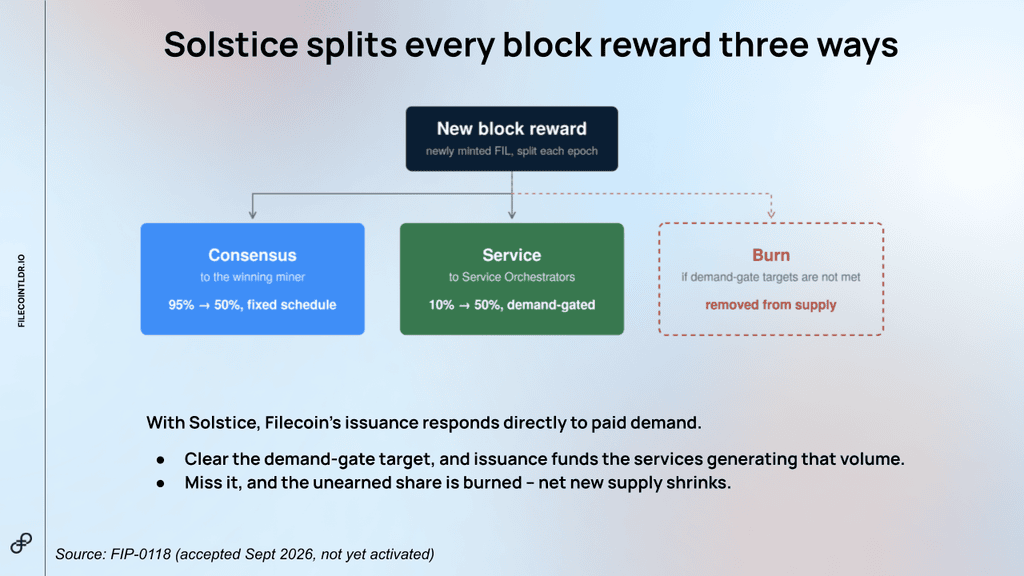
Each block reward is allocated across three destinations: the winning miner, Service Orchestrators, which are registered entities responsible for bringing paying customers to the network, and burn.
The miner share follows a fixed, published schedule, declining from 95% to a 50% floor over roughly nine quarters. As that share declines, the remainder becomes available to the service stream. How much of that remainder is actually allocated to Service Orchestrators depends on demand. Any portion that is not allocated is burned, permanently removing that FIL from supply.
b. The demand gate
The demand gate is the rule that determines whether the service share grows: each quarter, settled Filecoin Pay volume is checked against a pre-set target.
The service stream starts at 5% of block rewards and reaches 10% during the bootstrap quarter. From then on, each cleared target lifts the share by 5 percentage points automatically. The volume is measured from public on-chain settlement events, so the result can be independently verified.
The targets form a ladder. The first is set at $3,500 in quarterly volume, calibrated to Filecoin Pay activity around the time of the proposal. Each subsequent target is 2.7× the last, ending at roughly $3.66 million.
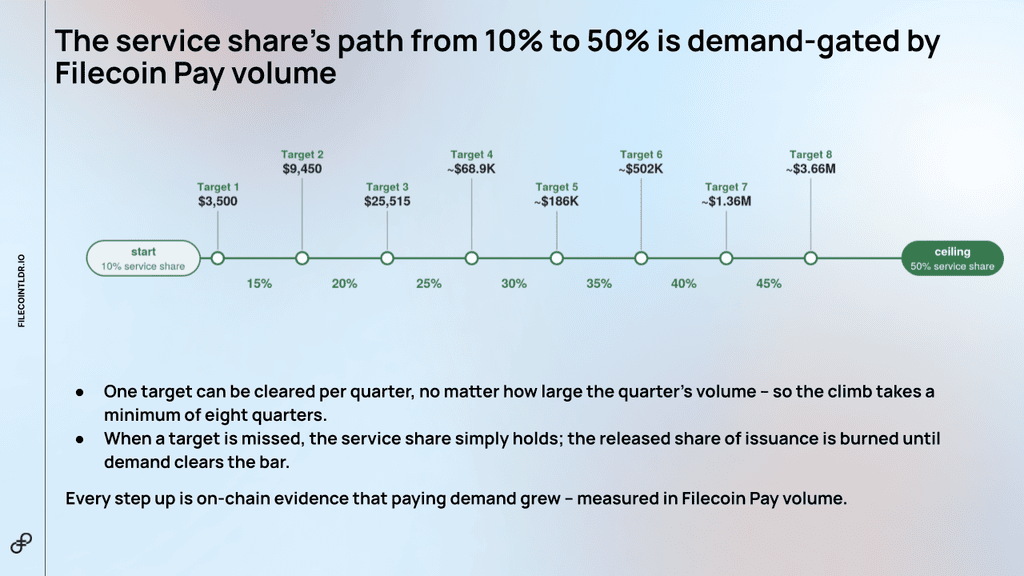
Reaching the 50% ceiling therefore requires progressively higher levels of paid demand over time.
c. The burn
The burn is not set by a separate schedule. It is simply whatever remains after the consensus and service shares are allocated: as the consensus share declines, any released issuance that paid demand has not earned is burned, permanently removing that FIL from supply — automatically, at each epoch.
If no demand gates were cleared after the bootstrap period, the burn would grow with each step of the consensus decline, reaching 40% of every block reward from the ninth quarter onward.
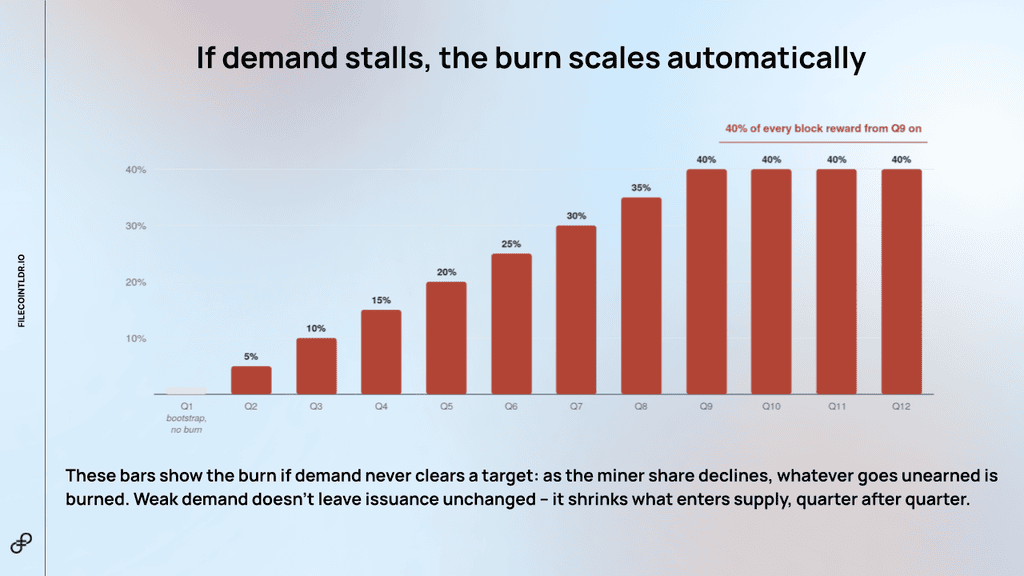
Each cleared target works in the opposite direction: another 5 percentage points of the block reward moves from burn into service funding. This is what ultimately ties issuance to demand – funding services when paid volume grows, tightening supply when it does not.
3. What the split looks like under different demand paths
The rules in the previous section define how each block reward is split. What that adds up to over time depends on how much paid demand actually shows up. To make that concrete, we built an interactive simulator that models how issuance is distributed across the consensus, service and burn streams under different demand paths.
A few notes before the scenarios:
- The window is 12 quarters. The consensus share reaches its 50% floor after roughly nine quarters, so a three-year window captures both the transition and the steady state that follows.
- FIL amounts assume roughly 20M FIL of annual issuance. This is the indicative figure used in the FIP, or about 60M FIL across the full window. Actual issuance will vary with network conditions, so the FIL figures are best read as a way to make the proportions tangible, not as forecasts.
- The model uses quarterly snapshots. The protocol updates weights at the epoch level, while the simulator displays quarter-end values. This means ramp-period bars and cumulative totals are approximate, including the Q1 bootstrap from 5% to 10%.
- Each scenario represents a different demand path. The scenarios assume different rates of Filecoin Pay growth, which determines which demand gates clear and when. They are illustrations of how the mechanism behaves, not predictions.
a. Base Case: steady growth clears some gates
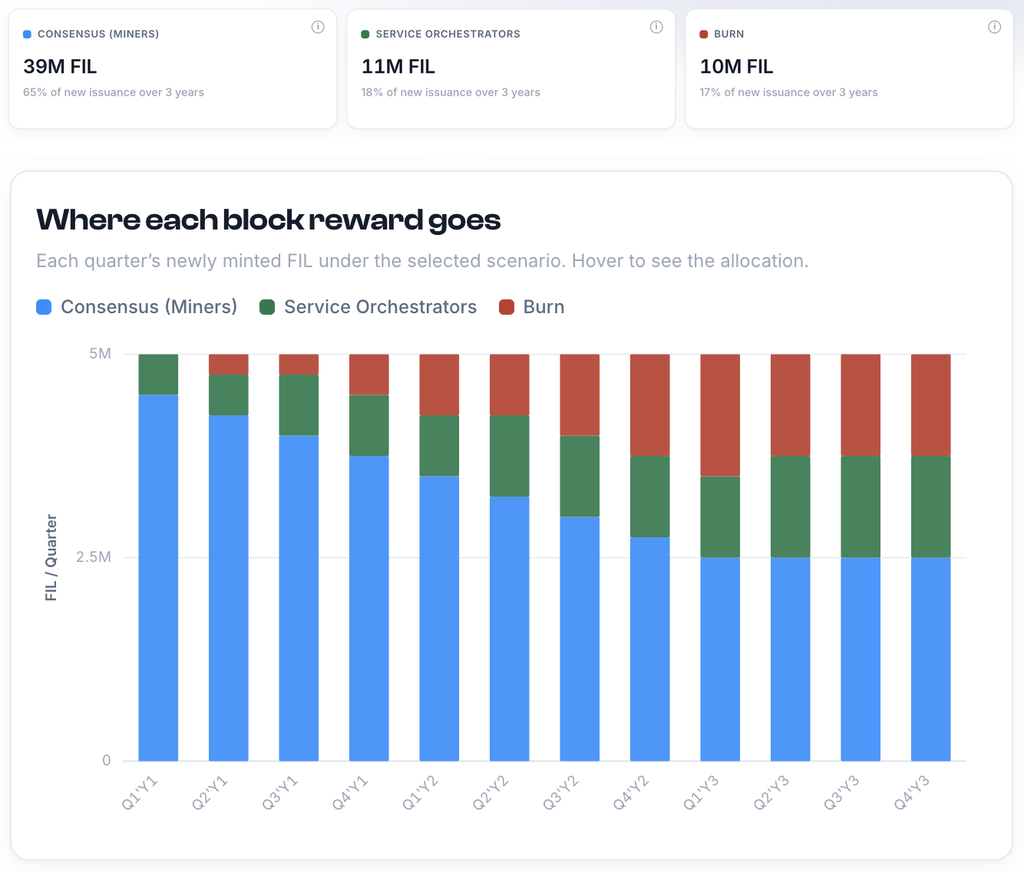
Base Case
- Assumption: Quarterly Filecoin Pay volume grows 30% every quarter for three years, clearing some demand gates while missing others.
- Output: The service share reaches 25% early in year 3, with a similar share of each block reward being burned by then. Across the full three-year window, 11M FIL goes to Service Orchestrators and 10M FIL is burned.
- Takeaway: Under steady growth, service funding and burn coexist. As paid demand grows, more issuance moves to the service stream; the portion demand hasn’t earned is burned.
b. Demand Surge: every gate cleared
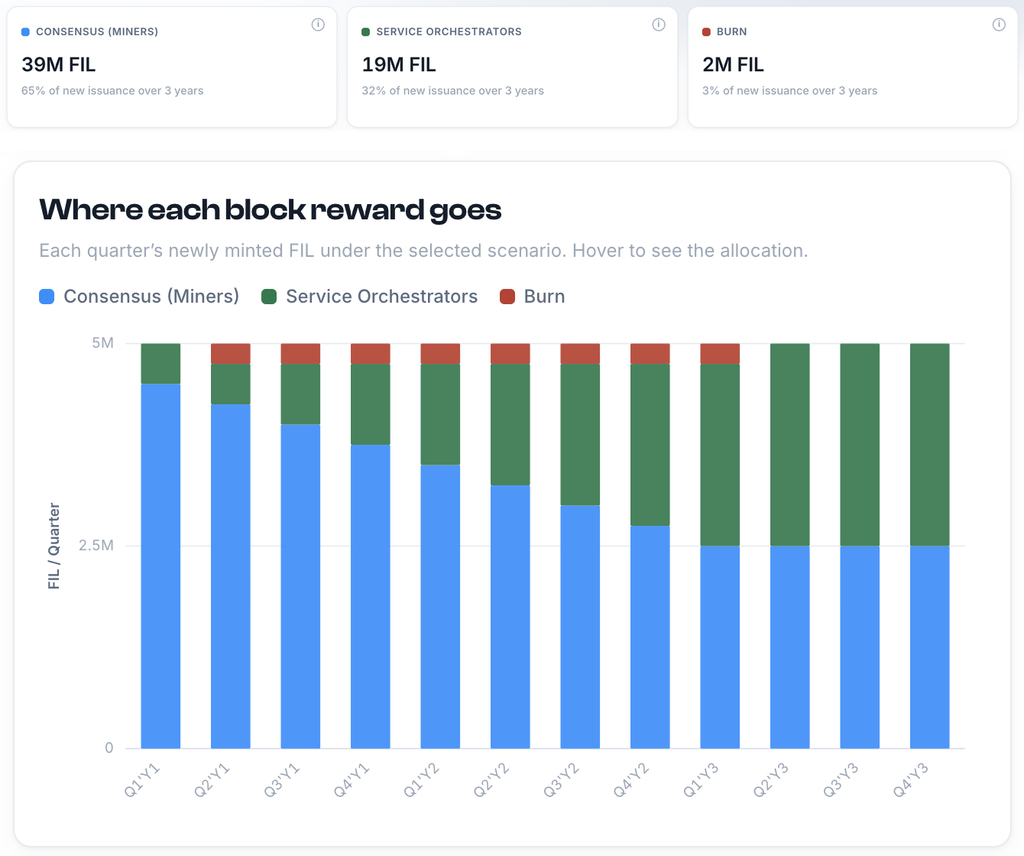
Demand Surge
- Assumption: Quarterly Filecoin Pay volume grows ~170% every quarter, clearing one demand gate every quarter, with all eight cleared early in year 3.
- Output: The service share reaches the 50% ceiling early in year 3, and from that point nothing remains to burn. Across the full three-year window, 19M FIL goes to Service Orchestrators and 2M FIL is burned.
- Takeaway: When paid demand clears every gate, issuance ends up funding both network security and the service economy, with nothing left unearned.
c. Demand Stalls: no gate cleared
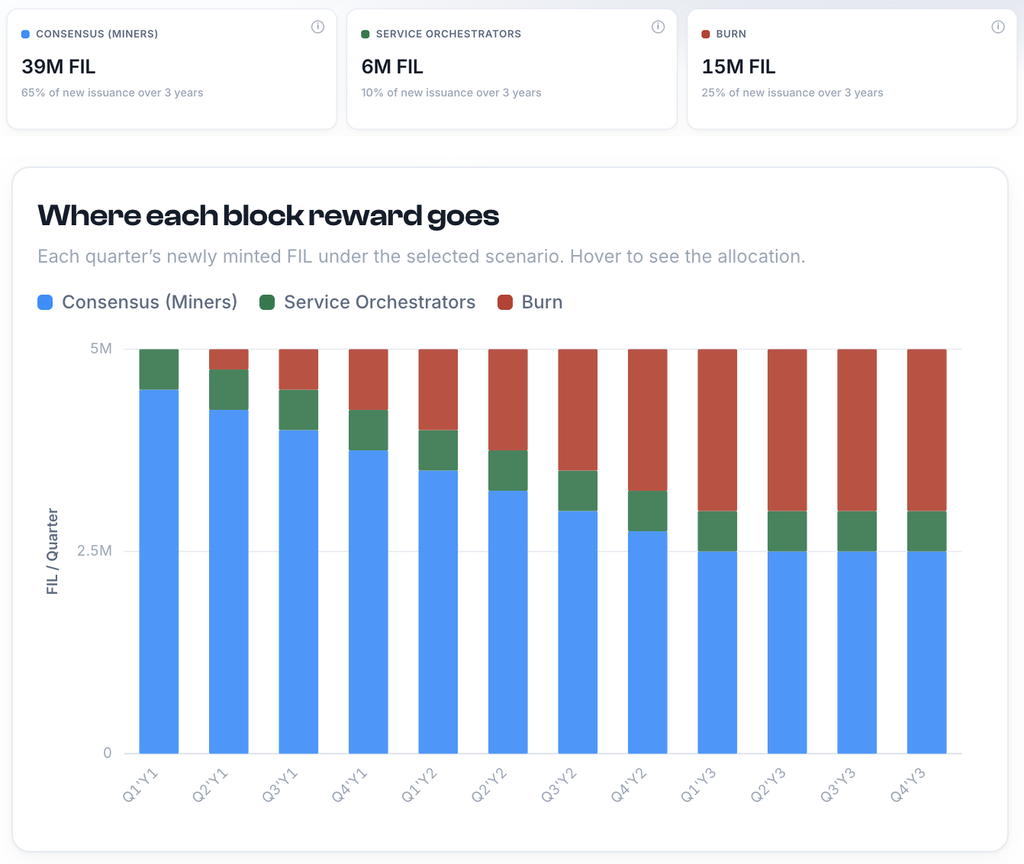
Demand Stalls
- Assumption: Quarterly Filecoin Pay volume stays below every target, holding the service share at 10% throughout.
- Output: By year 3, 40% of each block reward is burned in steady state, the same path shown in the burn section earlier, now expressed in FIL terms. Across the full three-year window, 6M FIL goes to Service Orchestrators and 15M FIL is burned.
- Takeaway: When paid demand does not clear the gates, the unearned share is burned rather than distributed. Weak demand therefore translates into lower net FIL issuance.
What to watch from here
Solstice is accepted but not yet activated; it will take effect in a future network upgrade (poised for nv29). Once live, the numbers that drive the mechanism, including quarterly Filecoin Pay volume, gate results and burn, will all be public. Each quarter will show how the mechanism is behaving in practice, and how that compares with the demand paths modeled above.
To build your own view of how the split could evolve, try the Solstice Simulator. You can switch between demand scenarios, inspect each quarter’s allocation, and compare every path against the pre-Solstice baseline. The simulator reflects FIP-0118 as accepted.
Keep exploring Filecoin
- Read Filecoin Network 2026 Overview & Update
- Follow FilecoinTLDR for ecosystem explainers and updates.
- Join the Filecoin Discord to connect with the community.
- Subscribe to the newsletter for future posts and insights.
Disclaimer: This information is for informational purposes only and is not intended to constitute investment, financial, legal, or other advice. This information is not an endorsement, offer, or recommendation to use any particular service, product, or application.